Thanks, Xi
September 20, 2026
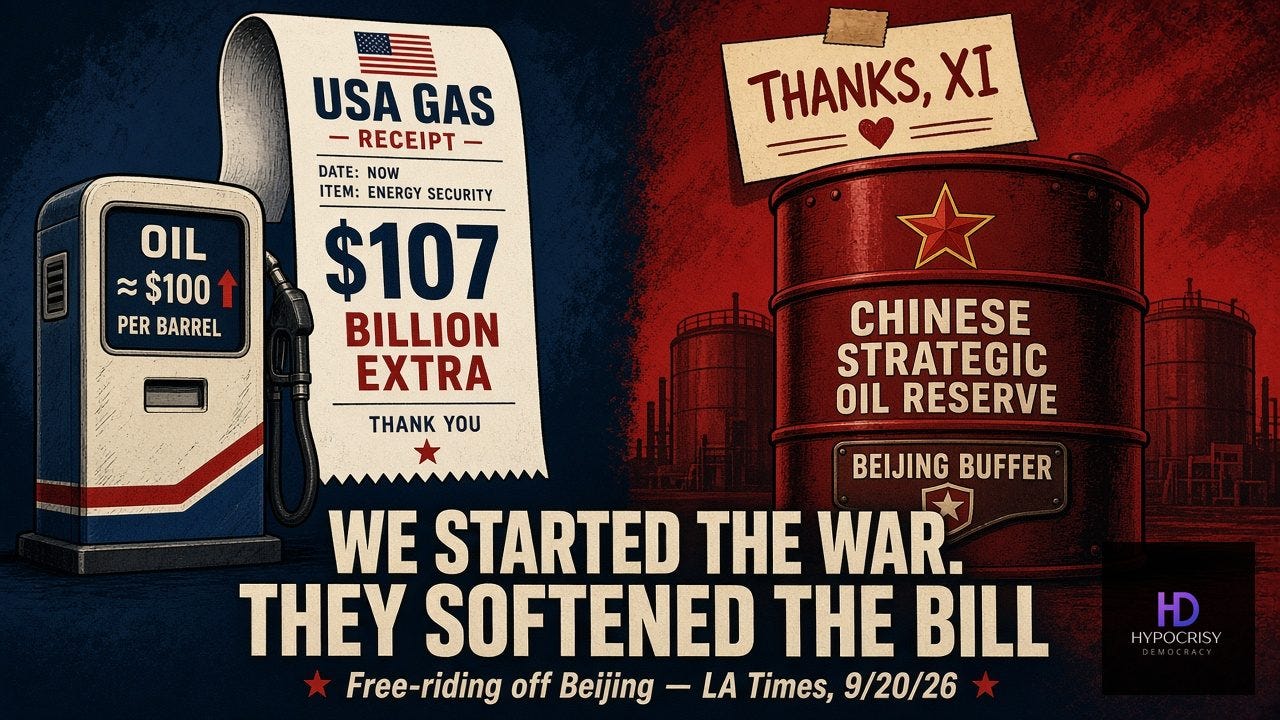
Brand: energy independence. Method: start a Middle East war, choke Hormuz, then free-ride on Beijing’s strategic reserve so the spike only hurts instead of detonates. Personal practice: call it a “little excursion,” a “very small price to pay,” and a problem that tumbles “right after the election” while the credit for not going full catastrophe quietly accrues to Xi Jinping.
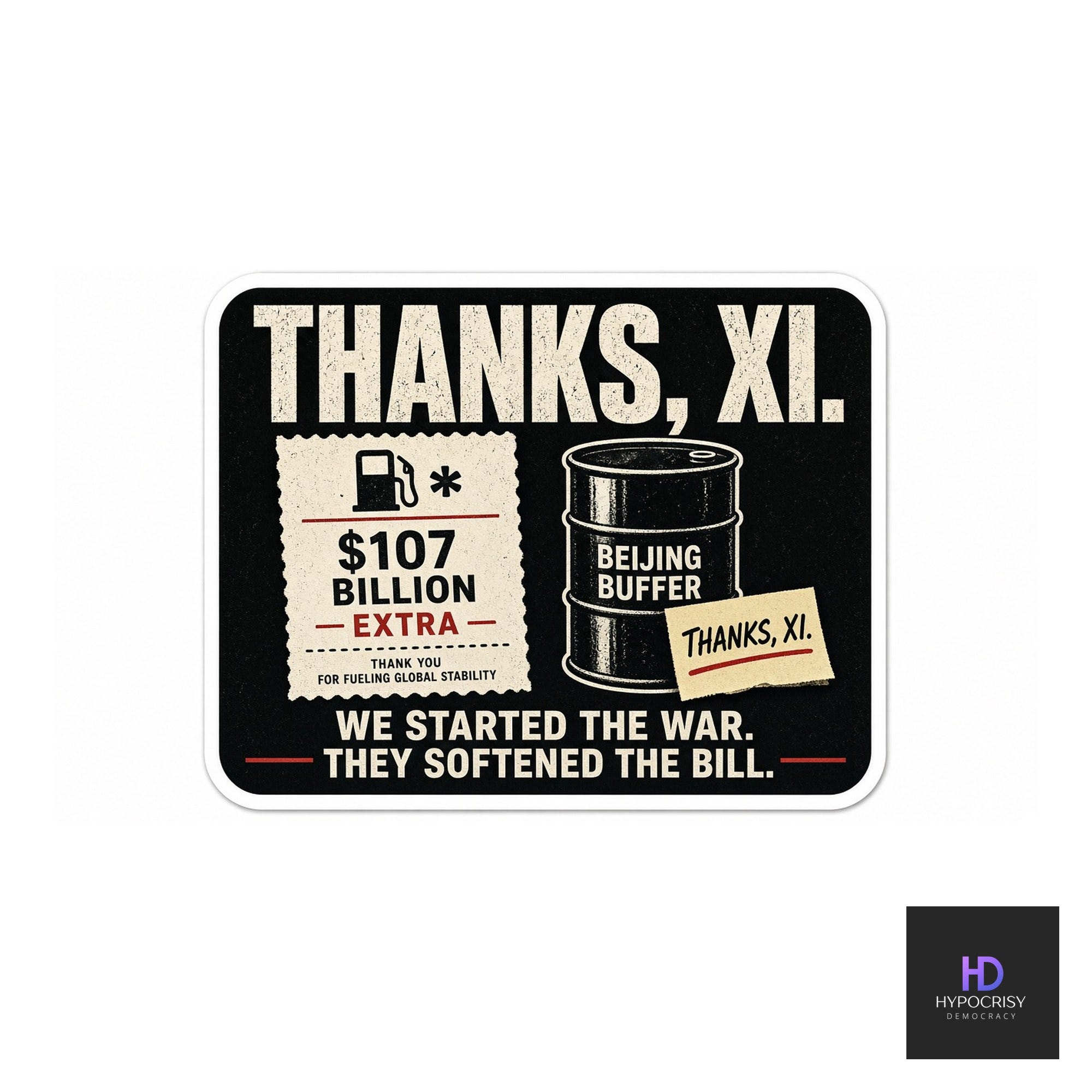
When your affordability story needs China’s five-year plan to stay merely bad, it isn’t toughness. It’s outsourcing the buffer.
Exhibit A: It Could Be Much Worse
Los Angeles Times / Associated Press this morning: oil is still high and volatile more than six months into Trump’s war with Iran. The most dire early forecasts — prices more than doubling — have not fully arrived. The reason analysts keep naming is not a sudden U.S. energy miracle.
It is China.
Beijing spent years and billions building the world’s largest crude stockpile — about 1.4 billion barrels by end of last year, per EIA estimates cited in the piece — then drew it down hard once Hormuz clogged. Chinas crude imports averaged just 8.1 million barrels per day in Q2, nearly 4 million bpd (32%) below Q1. EV shift and alternatives helped.
Retired Rear Adm. Mark Montgomery’s line in the Times: China did in ten years what took the U.S. twenty-five after 1973. Rosemary Kelanic’s blunter diagnosis: “We’ve been free-riding off Beijing in a weird way.
Xi Jinping arrives in Washington this week for high-stakes talks. The same week Republicans face voter fury over gasoline. The White House, asked whether Trump credits China for moderating the worst-case spike, did not respond.
So the scoreboard reads: America starts the war; China softens the bill; the White House shrugs when asked who gets the assist.
Exhibit B: The Twelve-Figure Tab America Still Paid
“Could be worse” is not the same as “fine.”
Wall Street Journal’s September accounting: U.S. consumers have collectively spent about $107 billion more on gasoline and diesel during the Iran conflict (and overlapping Russia-Ukraine disruptions) than they would have without war — cumulative gasoline alone about $59 billion above the no-war path, per Brown University climate-lab projections cited there.
Center for American Progress’s mid-September snapshot: national regular gas around $4.44 (about 49% above pre-war Feb. 27), diesel near record highs around $6.40, up more than 70% since the war began; Moody’s Mark Zandi put the war cost near $1,650 per household as of early September.
Reuters stagflation read last week: oil futures back above $100, diesel near records, jet fuel double pre-war February levels.
hypocrisydemocracy.nets morning tape today still shows WTI near $96 with a 10-year yield at 5.00% — the interest-rate twin of the energy shock. Markets can shrug. Grocery carts and diesel trucks do not.
The Times piece is careful: China’s buffer is being tested as the war spreads — Houthi disruption of Red Sea alternatives, Saudi pipeline shutdowns, Gulf talks on reopening Hormuz delayed. Bank of America still sketches $95–$120 if the choke holds, and spikes toward $150 if major infrastructure gets hit. Brent already averaged ~$69 last year and now hovers near $100, having touched $126 in late April.
So spare us the victory lap. The it could be worse” headline is a relative mercy purchased with someone else’s stockpile — while American households already wrote a twelve-figure check.
Exhibit C: Little Excursion, Small Price, Post-Election Discount
Track the presidential pricing of pain.
At the outset: a “little excursion” / “short-term excursion” to the Middle East (March, per AP/NBC write-ups). Oil spikes? A very small price to pay” for safety and peace — only fools would think differently.” Less than three months in, per the Times, he declared “everybody was wrong” because the most apocalyptic oil forecasts hadn’t landed.
Months later the calendar relocated: oil tumbles right after the election.” Yesterday’s Diesel piece already covered the Zelenskyy blame-shift. Today’s twist is quieter and worse: the residual gap between catastrophe and merely brutal is being attributed to Beijing’s planning while Trump still won’t say the quiet part out loud.
Also still on the tape: threats to hit Iran twenty times harder” if Hormuz stays closed, paired with careful public handling of China (Iran’s top buyer) and a shrug at reports Chinese entities supplied imagery ahead of a July strike that killed U.S. troops. Spy on us, we spy on them. The war stays “ours.” The buffer stays theirs.
That is not strategic clarity. That is having it both ways — own the toughness, outsource the cushion, bill the voter, credit nobody when asked.
Now Aim at Everyone
If a Democratic president launched a multi-month energy war, watched families eat a $107 billion fuel premium, then quietly enjoyed Chinas demand destruction as the reason prices weren’t worse — while calling the whole thing a short excursion and a small price — this site would say the same. Process that only applies to the other tribe is not process.
Democrats have their own version: sudden Hormuz literacy when the map is Republican, selective amnesia about freight inflation when the branding is theirs, and donor-class comfort with “temporary pain until the temporary refuses to end.
Pretending only one coalition treats household budgets as a campaign prop until governing makes them inconvenient is how audiences miss their own perfume.
Also true: strategic petroleum reserves are smart statecraft; China’s self-interest is not charity; Iran policy is a real fight. The adult critique is whether you admit whose buffer is saving your narrative. The immature critique is selling energy independence while free-riding on the rival you spend the rest of the week threatening.
The Questions Worth Asking
If China’s stockpile is the single biggest reason the spike isn’t worse, why won’t the White House say so when asked?
If this was a “little excursion” and a very small price to pay,” what exactly is a $107 billion cumulative fuel tab measuring — and who authorized that invoice?
If oil only tumbles “right after the election,” what calendar should households use while Xi gets the soft landing and Americans keep paying the hard one?
And if we’re free-riding off Beijing “in a weird way,” what does that do to the energy-independence stump speech — besides turn it into cosplay?
The Final Word
Cost-of-living politics deserves boring honesty: wars move oil; buffers move the ceiling; someone always pays the floor. What we got was a seven-month war sold as a short trip, a fuel bill sold as a small price, a recovery sold as a post-midterm gift — and this morning’s reminder that the reason it isn’t worse may be sitting in Chinese tanks, not American talking points.
Own the trade-off in daylight — this war is worth the premium, and thank you Beijing for the discount on catastrophe — or drop the independence costume. The pretending is the corrosive part. And today, the costume came with a thank-you card addressed to Xi.
— Hypocrisy Democracy
Receipts
Originally published on Substack.